
Legislative Policy Issues (Summer 2026)
Major Oregon Department of Corrections (DOC) Initiatives & Legislative Concerns
- DOC's Presentation during September Legislative Days - During the Legislature's September Legislative Days, DOC presented to committees on AIC Tablets, DOC's Continuum of Care for AICs, and our response to the Secretary of State's Audit on DOC's aging facilities and IT. Click here to watch DOC's legislative presentations.
- Oregon State Penitentiary Replacement - DOC's oldest facility is "no longer suitable for modern correctional standards and continues to pose a serious safety, health, and accessibility risks...." according to a recent Secretary of State audit, The 2025 Legislatively Approved Budget appropriated $3 million to begin the study of its replacement, which is underway and will be the subject of a 2027 report to the Legislature, along with a budgetary ask for the next phase of this critical work. Learn more.
- Geriatric Care - As the DOC prison population ages, medical needs become more significant. We are supplying information to various legislators about the national best practices we are aware of for providing a community-level quality of medical care to AICs while being fiscally responsible. Click here to go to the June 2026 House Judiciary Committee meeting on this subject, beginning at 1:20:21.
- Tablet Deployment - The Department of Corrections is working toward the goal of giving every adult in custody their own state-issued tablet. Read more here.
- Health Services - The Health Services Division has undergone a very public restructuring as a result of the Falcon Report. Hiring full-time healthcare workers in our institutions and rolling out an Electronic Health Records system have been major focus areas in 2026.
- Gender Informed Practices Assessment (GIPA) Response – DOC has made investments in gender-responsive and trauma-informed programming at Coffee Creek Correctional Facility (CCCF), Oregon's only women's prison. These efforts have included implementing evidence-based gender-responsive risk and needs assessments, as well as seeking training and technical assistance to enhance best practices. Learn more about DOC’s efforts here.
- Special Housing - New litigation and legislative concerns about solitary confinement have been a focus in 2026. DOC has made significant is currently focused on improving the transparency of our operations in this area. View our Special Housing Dashboard for more information.
- Modernization - DOC’s aging IT systems are increasingly difficult to use and maintain. DOC seeks to replace its 35+ year-old Corrections Information System and 40+ disconnected legacy systems with a unified, cloud‑based Offender Management System to eliminate manual, paper‑based processes and reduce operational, legal, and safety risks. Read more about the Secretary of State's view of this issue and DOC's response here: SOS Aduit Report
- Maney Lawsuit Settlement - The State of Oregon, in coordination with the Department of Justice, has reached a settlement in the Maney v. State of Oregon case, involving AICs exposed to COVID‑19 while incarcerated during the pandemic. Learn more about the case here: Governor's Office Press Release
- Wildfire Fire Crew Deployments and Institutional Concerns - As reported in this OPB article in early September, their efforts have a huge impact.. To learn more about the work of our AIC fire crews and the efforts our institutions take to protect against wildfires, please visit: Wildfire Response Information for Families of Adults in Custody | DOC Engagement
- Transgender Policies - Courts across the country have directed correctional systems to provide care for transgender adults in custody. This is another topic of a current lawsuit and one we field many legislative questions about. Learn more about this in our issue brief on the topic.
About the Department of Corrections
The Oregon Department of Corrections is primarily funded by state tax dollars, so we strive to be accountable and transparent in our operations to the people of Oregon via their elected leaders.
DOC operates 12 prisons across the state that house almost 12,000 adults in custody (AICs). To operate these institutions, over 4,700 employees keep these facilities operating on a 24/7 basis. This is not to mention the many contractors, volunteers, and program partners also help us meet our goals.
Additionally, DOC provides oversight to Community Corrections operations in every county in Oregon, who in turn provide parole and probation services to over 30,000 offenders across the state.
Our 3-Year Strategic Plan is now published; in it you can see where we hope to implement change across our organization to better serve your communities.
Other valuable resources on this page are:
- Signing up for updates (right menu)
- Sign up for events (right menu)
- Do policy research using Issue Briefs (right menu)
- Share policy ideas & ask questions (must register at the upper right, then these options will appear below)
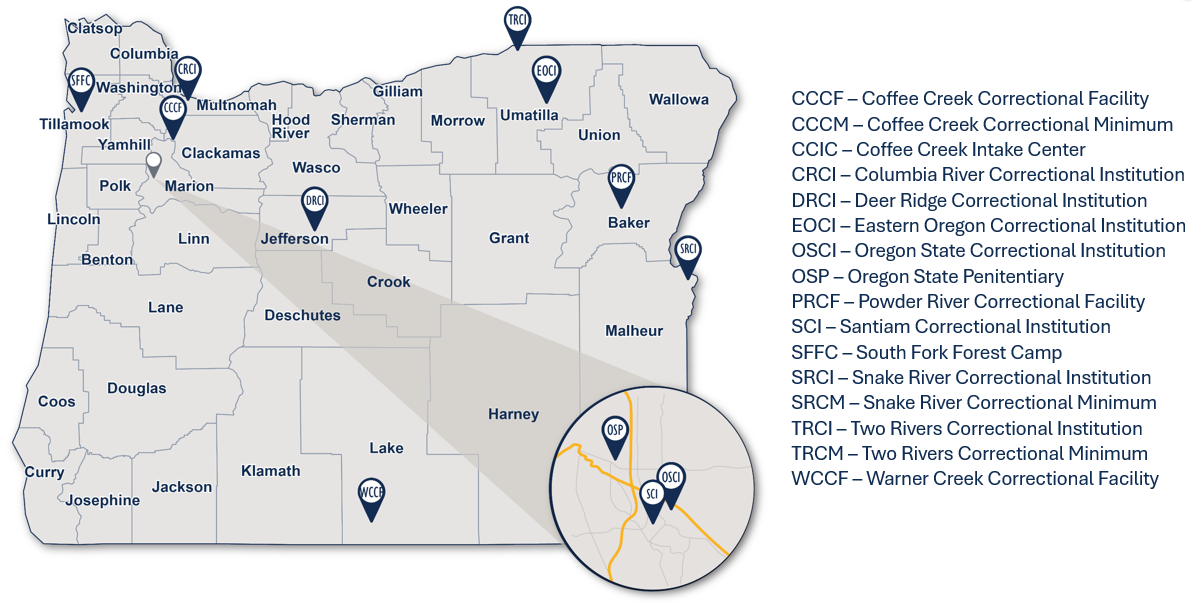
Understanding the Adults in Custody (AIC) population is essential to supporting informed decision‑making. The data presented in the links below offers an overview of key trends within our AIC population, including demographic characteristics, housing assignments, and changes over time.
-
 2026 Issue Briefs
-
2025 Issue Briefs
-
 Community Corrections Cost Study (152 KB) (pdf)
-
Earned Time Credit (198 KB) (pdf)
-
Electronic Health Records (147 KB) (pdf)
-
Food Services (118 KB) (pdf)
-
GIPA (575 KB) (pdf)
-
Transgender and Intersex (125 KB) (pdf)
-
CCCF (207 KB) (pdf)
-
CRCI (190 KB) (pdf)
-
DRCI (190 KB) (pdf)
-
EOCI (193 KB) (pdf)
-
OSCI (191 KB) (pdf)
-
OSP (205 KB) (pdf)
-
PRCF (191 KB) (pdf)
-
SCI (188 KB) (pdf)
-
SFFC (192 KB) (pdf)
-
SRCI (191 KB) (pdf)
-
TRCI (207 KB) (pdf)
-
WCCF (205 KB) (pdf)
-

-

Phone 5035104801 Email harvey.t.mathews@doc.oregon.gov -