
FAQs
- Approved communication tools (Electronic Message)
- Educational programs
- DOC content and information
- Certain entertainment features, such as games, movies, magazines, and books.
- DOC continues to offer communication services below the FCC rate caps.
- DOC has a phone rate of $0.09 per minute including all taxes. (The maximum rate cap for prisons would allow for $0.11 per minute plus taxes.
- DOC has a Video rate of $0.21 per minute including all taxes. (The maximum rate cap for prisons would allow for $0.25 per minute plus taxes.)
- Access to movies, games, messaging, etc. are all offered at a rate of $0.04 cents per minute.
- Access to DOC handbooks, announcements, and education content remain on the free side of the tablet.
- DOC continues to offer communication services below the FCC rate caps.
- DOC has a phone rate of $0.09 per minute including all taxes. (The maximum rate cap for prisons would allow for $0.11 per minute plus taxes.
- DOC has a Video rate of $0.21 per minute including all taxes. (The maximum rate cap for prisons would allow for $0.25 per minute plus taxes.)
- Access to movies, games, messaging, etc. are all offered at a rate of $0.04 cents per minute.
- Access to DOC handbooks, announcements, and education content remain on the free side of the tablet.
01 What is the DOC tablet deployment project?
DOC is working toward providing personal tablets to Adults in Custody (AICs). These tablets will support communication, education, programming access, and other approved tools. This effort is part of DOC’s broader modernization work, including technology and communication improvements.
02 Will every AIC receive a tablet?
DOC is planning for a 1:1 tablet model, meaning every AIC would receive their own device.
03 Why is DOC expanding tablet access?
Tablets support rehabilitation, access to information, and positive family connections. They also help DOC deliver secure digital content, education modules, and communication tools efficiently.
04 When will tablets be available?
Rollout planning is underway, and DOC will communicate timelines once they are finalized. Current estimates begin rollout in September of 2026.
05 What can AICs do on the tablets?
Depending on final contract terms, tablets may provide access to:
06 Will families need to do anything to support tablet rollout?
No. Families and friends do not need to take any action at this time. There are no changes to how you make phone calls, schedule visits, or send mail.
07 Will tablets cost AICs money?
Some features may be free, and others may involve fees. Pricing will depend on the contract DOC negotiates. Early planning documents show examples of free monthly minutes, messages, or calls in some scenarios, but these are not final.
08 Will AICs receive training on how to use the tablets?
Yes. DOC will provide instructions and orientation materials so AICs know how to use their tablets safely and effectively. The tablets have been deployed within ODOC for several years now.
The tablets deployed use both picture Icons and text for navigation. Spoken identification of icons and content is also available as part of its ADA features. This should address the navigation concern to the scanned mail application.
The scanned mail will be exact representations of whatever content was physically sent in, so it should match the anticipated reading level of the AIC, so long as the sender took that into consideration.
AICs will still have the ability to respond to Friends and Family through paper mail if they choose.
09 Will staff be affected by tablet deployment?
Some workloads may shift slightly as digital communication increases as a result of more AICs having access to tablets more often, but DOC will support staff throughout the transition.
10 Are taxpayers paying for the tablets?
Tablets would be provided by the vendor. Costs for the tablets would not come out of the DOC budget.
11 Will the AIC be responsible for covering costs if they damage the tablet?
If the damage is intentional, the AIC could receive a finding of a Property 1 violation, and the AIC may no longer receive access to a personal device. In addition, the vendor may seek financial compensation outside of ODOC administrative processes. Any other misuse will result in appropriate disciplinary action.
12 Will tablets be charged in the cells?
We anticipate AICs will be charging tablets in cell using the standard outlets already installed. We are aware SRCI will present a unique challenge for in cell charging and are evaluating options.
13 How will DOC prevent vulnerable AICs from being taken advantage of?
AICs are provided with unique log in PIN. It is every AIC’s responsibility to protect their PIN. In the event an AIC feels as though they are being taken advantage of they should notify security staff at their facility. If they do not feel comfortable reporting to their facility staff, they can contact their inspector 1 to have their PIN changed and/or report through the Inspector General hotline.
14 Will access to tablets be restricted for AICs who are celled in on a conduct order or serving a LOP sanction?
The system allows suspension of an AIC’s PIN and can provide content options based on incentive level. We anticipate the new deployment should allow more consistent application of sanctions and incentives.
15 If misuse of the tablet happens what will the consequences be?
If damage is intentional, the AIC could receive a finding of a Preoprty 1 violation, and the AIC may no longer receive access to a personal device. In addition, the vendor may seek financial compensation outside of ODOC administrative processes. Any other misuse will result in appropriate disciplinary action.
16 Will physical letters received be digitalized and sent through the tablet to the AIC or will they still receive letter and photos sent through regular USPS Mail?
The physical mail will be sent to an outside company. That company will scan the contents and provide those scans to AICs via an app on the tablet. This will include letters and photos. Physical mail will no longer arrive at the facility. (Exceptions: legal mail, package authorizations, books, magazines)
17 Will it be possible to order canteen items or incentive items?
Some order forms for large items have already been established. After the scope of this project is complete, ODOC can examine expansion of service offerings.
18 Will AICs be able to access through the tablet special services, such as: mental health treatment, sex offender treatment, and batterer's intervention?
The current transition is looking to expand the devices while maintaining current level of services, which currently does include self-help modules through Edovo and CypherWorx.
19 Will tablets replace any current communications systems?
Tablets will enhance communication options but will continue to operate within DOC’s existing policies and security structure. Any future changes to communication platforms will be announced separately. The process for scheduling phone calls, visits, and sending mail all remain the same.
20 Will AICs pay per minute to view a message that was already paid for by the contact that sent the message?
The scanned mail application will exist on the free side of the tablet. It has not yet been determined if electronic messaging application will be move to the free side of the tablet. The move would enable free viewing of messages, but will result in a per message charge rate for responses.
21 Is it possible for AIC tablet communications be monitored so as to prevent contact with prohibited persons (for example: victims, underage targets, gang associates)?
AIC communication is subject to monitoring and recording. If there is knowledge of unwanted or inappropriate contact being made by an AIC, please report it.
22 Will tablets increase communication opportunities?
That is one of the goals of the project. Planning documents include options that expand communication minutes, messaging allowances, and video call access, depending on the final contract. These are not finalized.
23 Will AICs be able to print mail they have received digitally?
The ability to request prints of mail will be determined in the coming months.
25 Will AICs pay per minute to view a message that was already paid for by the contact that sent the message?
The scanned mail application will exist on the free side of the tablet. It has not yet been determined if electronic messaging application will be move to the free side of the tablet. The move would enable free viewing of messages, but will result in a per message charge rate for responses.
26 Will AICs still be able to receive physical photos?
Physical photographs will not be allowed to enter the facilities. All mailed photographs would be scanned and provided via the scanned mail application on the tablet. ODOC has long offered the ability for photographs to be sent to AICs digitally. The digital image option typically ensures the highest quality of photograph is accessible to the AIC while avoiding printing and mailing costs.
27 Are the prices going to be different than what is charged now?
The services and costs currently charged are expected to remain the same. We will be exploring options for moving the messaging application out of the pay per minute side, which would result in a pay per message model, but would allow unlimited viewing of received items at no additional cost for the AIC.
28 Will a sender be able to send digitized mail and pictures from a personal tablet or phone directly to the tablet or will all mail have to be scanned by prison staff?
Electronic messaging and photo sharing will continue to be available through the “Getting Out” application or web page. Standard Non-Legal physical mail will be received and scanned by a contractor.
29 Will digital photos and digital text messages be reviewed for content? What timelines will govern ODOC handling these items?
Electronic messaging and photo sharing will continue to be available through the “Getting Out” application or web page.
All Communication is subject to security review. The Rule governing the process will be a combination of Oregon Administrative Rules 130 and 131. Both of which will be updated as part of this process.
30 Will AICs have a local storage device? What are the storage limitations?
The electronically stored mail will be maintained by the vendor. Onsite electronic storage for AICs will not be offered on the tablet. DOC does not sell, nor can AICs purchase digital content under the model. They instead pay for the time used on the device for the premium content.
31 If an AIC loses the privilege of using a tablet, how will they receive mail?
ODOC anticipates wall mounted tablets being available on housing units for AICs who have lost privilege to a personal tablet or are awaiting a repair to be addressed.
32 How will AICs sign and return original documents?
We will be looking into options around printing requests and appropriate mail to allow for physical copies to be printed and received.
33 In special housing units where an AIC might not be allowed access to a tablet or phone, how will those AICs receive their mail?
With personally issued Tablets, ODOC will be able to limit profile access to content that is appropriate for the AIC’s current custody and incentive level.
While there may be circumstances when the personal tablet will not be allowed in cell full time, ODOC will ensure practices and procedures are developed for appropriate access to mail.
34 Will the AIC have unlimited communication with family?
Hours of availability will likely be established and enforced. So long as the communication meets ODOC rules and contributes to an individual's rehabilitation, we do not foresee a "limitation" being placed on communication.
35 Does having a tablet eliminate phone calls and video chats?
The other services currently offered will remain in place unchanged. Video calls will be available on the Kiosks within the facilities. Phone calls will be available on the phones within the facilities.
36 Will the tablets take the place of phone calls? Can AIC use them anytime time and in their cell?
The tablets will not take the place of phone calls. We will likely have hours of network availability established within the facilities.
37 Are AICs able to purchase tablets for themselves and get them sooner than when they would be distributed to everybody?
No. Personally-owned tablets are not available or allowed.
40 If the AIC is moved to another facility, do they take their tablets with them?
Yes, once a tablet is issued, it is expected that the AICs will be transferred between facilities along with their assigned tablet.
41 Will Legal Mail be affected?
The legal mail process is going to be reviewed, however we do not anticipate scanning of legal mail.
42 If an AIC is released, what happens to their pictures and letters that are on the tablet?
We will be exploring options with the vendor.
43 Is there a warranty?
The tablets will be maintained by the vendor as part of the contract.
44 Will the inmates with their own tablets be able to send and receive text messages to family and friends 24 hours a day, as long as they have funds on their accounts to do so?
Hours of availability will likely be established at each site.
45 Will the mail still be delivered since the original is not being sent to the inmate?
The received physical mail will not go into the prisons. We have not yet determined the final disposition of the original mail. We will be having conversations in the near future to find out what options exist. It is our understanding that the vendor keeps the originals for a set period of time and then disposes of them. This initial retention period is to ensure that no issues exist with the scans. We will be exploring what options exists.
46 What happens to our original mail after you scan it, and why can't we receive our mail back after scanning it?
We have not yet determined the final disposition of the original mail. We will be having conversations in the near future to find out what options exist.
47 Are you trying to sanction magazines and books from reputable sources due to these tablets and mail?
DOC is not attempting to sanction magazines and books. We are working to address the growing threat of contraband introduction via soaked paper and concealed drugs within mail and provide a safe environment for AICs and staff.
48 Will we be able to send photos via Pelipost, or other inmate photo companies?
There will be no requirement to use specific vendors, as all mail will be scanned by the third-party vendor (with the exception of books, magazaines, and Legal Mail).
49 Will the AICs be able to send hard-copy mail to family and friends, or will families receive their letters scanned to their email?
Outgoing mail does not change. AICs will continue to purchase postage-paid envelopes from Canteen and mail them out as they currently do.
50 If the AIC is moved to another facility, do they take their tablet with them?
Yes.
51 How long will letters and photos be available for the AIC to view on their tablet?
The mail processing process is still under development. As new processes get established, communication clarifying the changes will be shared.
53 How will rejected mail be handled/notifications sent (digitally or using the existing Mail Violation form)?
The mail processing process is still under development. As new processes get established, communication clarifying the changes will be shared.
54 How will catalogs, newspapers, magazines, and other periodicals be handled?
Catalogs, newspapers, magazines, and other periodicals from approved sources will still be delivered as physical mail.
55 What happens to mail from courts that is not labeled “legal mail” but is still legally relevant?
If any part of the mail doesn't meet the standard of "Legal Mail" per OAR 291-131 (including being properly marked), it will be treated as regular mail, scanned, and delivered electronically as general mail.
56 How will sensitive official mail (e.g., VA mail, documents containing Social Security numbers) be protected from third-party access?
If the mail it meets the standards of "Official Mail" per OAR 291-131-0025, it will be physically delivered. If it does not, it will be treated as regular mail, scanned, and delivered electronically as general mail.
57 What legislation or policy authorizes the transition to scanned-only mail?
The authority for these rules is granted to the Director of the Department of Corrections in accordance with ORS 179.040, 423.020, 423.030, and 423.075.
58 Will the scanned mail affect correspondence courses and access to textbooks, assignments, and educational material?
ODOC will evaluate the impact on approved programs as the project moves forward. At this time, that impact is unknown.
60 Will services (games, movies, messaging) become free, cheaper, or remain the same?
Services will remain the same. Future potential changes will be assessed and communicated as needed.
61 What capabilities will the new tablets include?
DOC is exploring what capabilities and features will be available on the tablets. We will communicate more information closer to implementation.
62 Will the tablets support video visits?
Video calls/visiting will not be available on the tablets. Secure mounted kiosks will remain at facilties for video calls.
63 Will accessories be available (i.e. protective covers, keyboards)?
No, The tablet is made of a robust shell that protects the components while still being able to be easily inspected. Additional covers will not be placed on the tablet.
External Keyboards will not be available. The tablet uses a touch screen keyboard.
65 Will the contact vaildation process change?
Current safety protocols and validation processes will remain in place. ODOC is committed to safe, secure, and consensual communication between members of the public and adults in custody.
66 Will AICs be able to contact people not currently on their approved call lists?
AICs will only be able to communicate with those who register and validate accounts.
70 Will tablet functionality issues be addressed before full implementation, such as wifi instability, login errors, and app crashes?
Tablet functionality is continuously monitored and addressed under the current deployment. These practices will continue.
Wi-Fi mapping will be part of the preparation work for this project.
71 What happens to mail access if wifi goes down or the tablets maflunction?
While the network is down, mail will not be available. Complete network outages are rare and typically impact the rest of the facility's operations as well.
For single device failure, we anticipate having mounted tablets available in common use spaces for AICs to access their mail while they await the repair.
73 It's my understanding is the State won’t be purchasing these tablets. Is there contractual language stating that the State won’t be financially responsible for their repairs, replacement, or upgrades?
The tablets being issued by DOC will be owned and operated by the vendor. The state will not assume lifecycle management or antivirus maintenance. We will monitor activity to ensure we are tracking and managing any security risks.
75 Will physical photographs be allowed in for special occassions?
We understand the importance of photo sharing. DOC is exploring the option of allowing photos from verified commercial vendors (such as Shutterfly or Snapfish) as a safer solution. Unfortunately, even limited-time allowances present significant security concerns. There have been documented instances of contraband being introduced through altered photo materials.
76 Will visitors be able to leave physical photographs with their AIC when they visit?
Allowing photos to be left during visitation creates an additional entry point for contraband. Maintaining consistent security protocols across all entry points remains a priority.
77 How will tablets be handled in segregation?
Procedures for tablet use in special housing units are still under development. Current considerations include the use of wall-mounted, secure login devices, as well as issued tablets based on individual behavior and facility guidelines.
78 Will printing kytes for legal purposes be available?
At present, DOC does not provide copying services for handwritten kytes. Expanding this service would require additional staff resources and processes to verify legal correspondence and manage associated costs.
79 Will AICs be able to have video visits in their cells on the tablets?
For security reasons, mobile camera devices are not permitted within DOC facilities. Video visitation will continue to be conducted using secure, fixed-location equipment as it is today.
80 Will tele-health visits be available on the tablets?
Tele-health services are not part of the current tablet initiative.
81 What is the time frame for having a tablet repaired or replaced if it breaks?
DOC will develop repair and replacement procedures as part of the CCSM project. Facilities will maintain an inventory of spare tablets to support timely replacements when needed. Resolution timelines may vary depending on the nature of the issue. For security reasons, individuals will not be authorized to perform repairs or modifications on vendor-owned equipment.
83 Who is funding the infrastructure improvements necessary for the tablets to be effective?
Basic/universal electrical (110) infrastructure is DOC's responsibility, while any expansion or upgrade needed for the electrical communication system network is the responsibility of the vendor.
84 Will AICs be able to use any free minutes they receive for printing instead of calling?
Previous experience has shown that printing electronic communications carry associated operational costs, including materials and staff time. Additionally, DOC is currently evaluating any free services that may be offered.
85 Will AICs receive any limited-time, free printing incentives?
While the idea of limited-time incentives is appreciated, such offerings can lead to a surge in demand that may exceed current staffing capacity. Printing services also carry associated operational costs, including materials and staff time.
86 Will indigent AICs have access to their mail?
Ensuring equitable access remains important. Individuals without funds will continue to have free access to scanned photos, which can be viewed on their assigned tablets.
87 Will the video call rates change?
Video call rates will remain unchanged. In alignment with the Martha Wright-Reed Act, 28-minute sessions must now be scheduled in advance at a rate of $0.21 per minute. Any unused time at the end of a session will be refunded to the paying party.
88 Can AICs earn extra free tablet time or free messages for completing programming or training?
ODOC has a performance reward system for successful programming that functions outside of the vendor's platform. While AICs certainly can use their PRAS rewards to purchase time on the tablet, the systems are not directly connected.
89 Will the prior tablet mail and photos be tranferred to the new tablets?
The tablets and electronic messages and photos would likely not be transferred if there is a shift in providers. We have not yet had the opportunity to determine transferability of scanned mail. This is an area we will be collecting more information on.
90 For AICs serving long sentences, will all of their mail/photos be available throughout their entire incarceration?
Retention schedules are an area that is still being looked into.
91 Which vendor was chosen to provide the tablets?
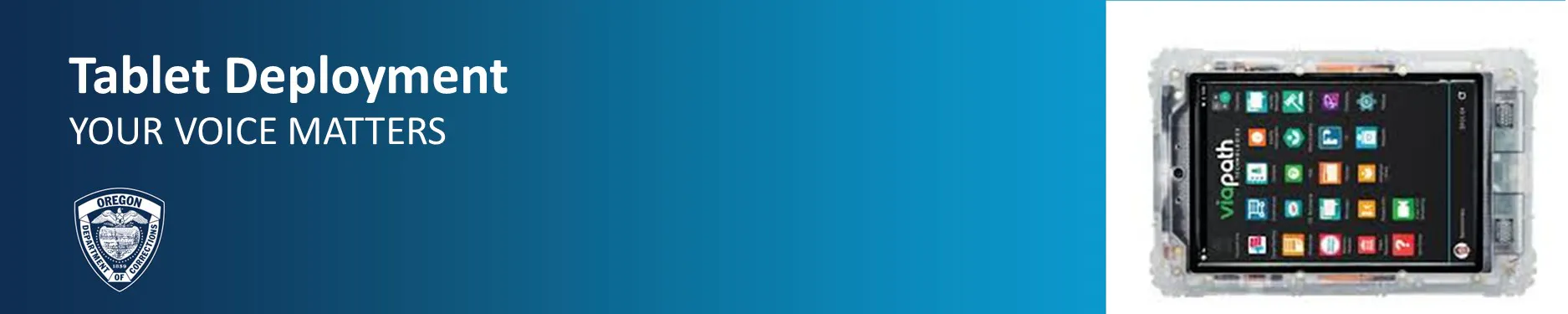
The contract is with IC-Solutions. They are deploying ViaPath tablets under this contract.
92 What happens to the original of the scanned items?
We are being told that multiple options around what happens to mail exists. We will be exploring what options are available as the project moves forward. The contract for scanned mail has not yet been negotiated.
93 Will AIC be able to access the law library resources from the tablets?
Not at the time of 1:1 deployment, but this is an area ODOC will be looking into.
94 Do senders need to register an email with the AIC like we had to register our phone number for them to call?
The electronic messaging platform will continue to be the GettingOut messaging application from ViaPath. Physical mail sent in will not require any account creation.
95 Can you clarify the funding source for infrastructure upgrades to support the tablets?
ODOC is responsible for electrical infrastructure. The vendor is evaluating the network infrastructure and will provide the additional equipment needed.